
The world is filled with lousy songs leavened by nifty fretwork, but how do we know when the axe-slinger is gonna sling his or her axe? And often, how do we even know if said solo is any good? Why, via the medium of annunciation.
It’s the exhortation which precedes or comments on the mighty solo but, most often, helps usher in the unleashing of the beast, so to speak. And sometimes these expressions can be as notable as the very solos they herald…
This particular musical quirk has a multitude of cousins, distant relatives and mutations, so I decided to lay out some basic thoughts and collect a few examples in a Spotify playlist. It is, of course, FAR from exhaustive but merely intended to illustrate the phenomena. Also, asking a few friends for examples over the years has revealed quite a few unknown to me; so additions will, and can be made in the future. Just add comments and it will be so! But for now, let’s look at some examples – sorted under a few of the main ‘genres’ of annunciation – in a bit more detail.
GENRE 1: Instinctive: I just can’t control myself
Beatles Back In The USSR 1’20” ‘Oh, c’mon!’)
The Beatles – A Hard Day’s Night (1’18” ‘*scream*’)
David Bowie – Suffragette City (1’35” ‘Oh hit me!’)
The Kinks, You Really Got Me (1’16” ‘Oh, awlriiurghsplurgh’)
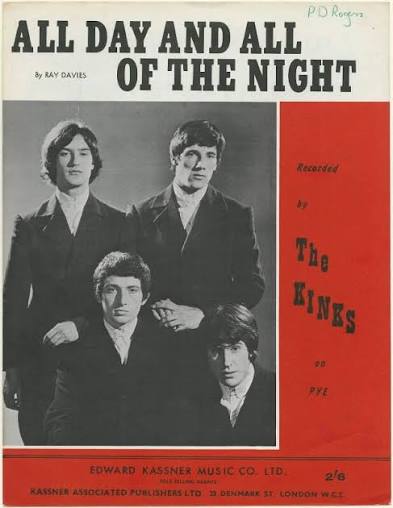
The Kinks, All Day And All Of The Night (‘1’19” Oh, come ON’)
Rick Derringer, Rock ‘n’ Roll Hoochie Koo (1’41” ”Yeah, did somebody say keep on rockin’?’, plus scream)
Screams of abandon. Until the mid-50s such things were rarely if ever heard on recordings. If you want proof of the sheer transformative power of evil electric guitars, there it is. The scream, which the guitar so often attempted to mimic, was inextricably linked to wood, steel and hot, hot valves. Quite right, too. This first genre explores the earliest examples of annunciation, and thus, the most primal of all: The wild explosions from the throats of young men (in the main) who knew exactly what was about to happen and wanted the world to know that HERE COMES THE FUCKING GUITAR SOLO AND ITS GONNA BE LOUD!
The earliest examples of the craft of annunciation stem, of course, from the craft of rock ‘n’ roll: the guitar ‘solo’ being a descendant from the world of jazz (I’m not going to delve into the murky waters of anything classical here). Soloists were key to the development of 20th century popular culture; and yet it wasn’t until the hormone-fuelled over-excitement of teenage dance forms that a solo could be regarded as something worth literally shouting about. I’m aware that somewhere out there are examples of proto rock ‘n’ roll that approach the form (there HAS to be a Louis Jordan, Bill Haley, or old jump blues track that does this – I just can’t be bothered to find it at present, although some early 60s trad revival hits do have some pretty excitable noises: c.f: Kenny Ball and his Jazzmen’s Rondo (1963)), but as it stands I’m jumping forward to mid-1964 for my first annunciation on annunciation:
The Beatles – A Hard Day’s Night
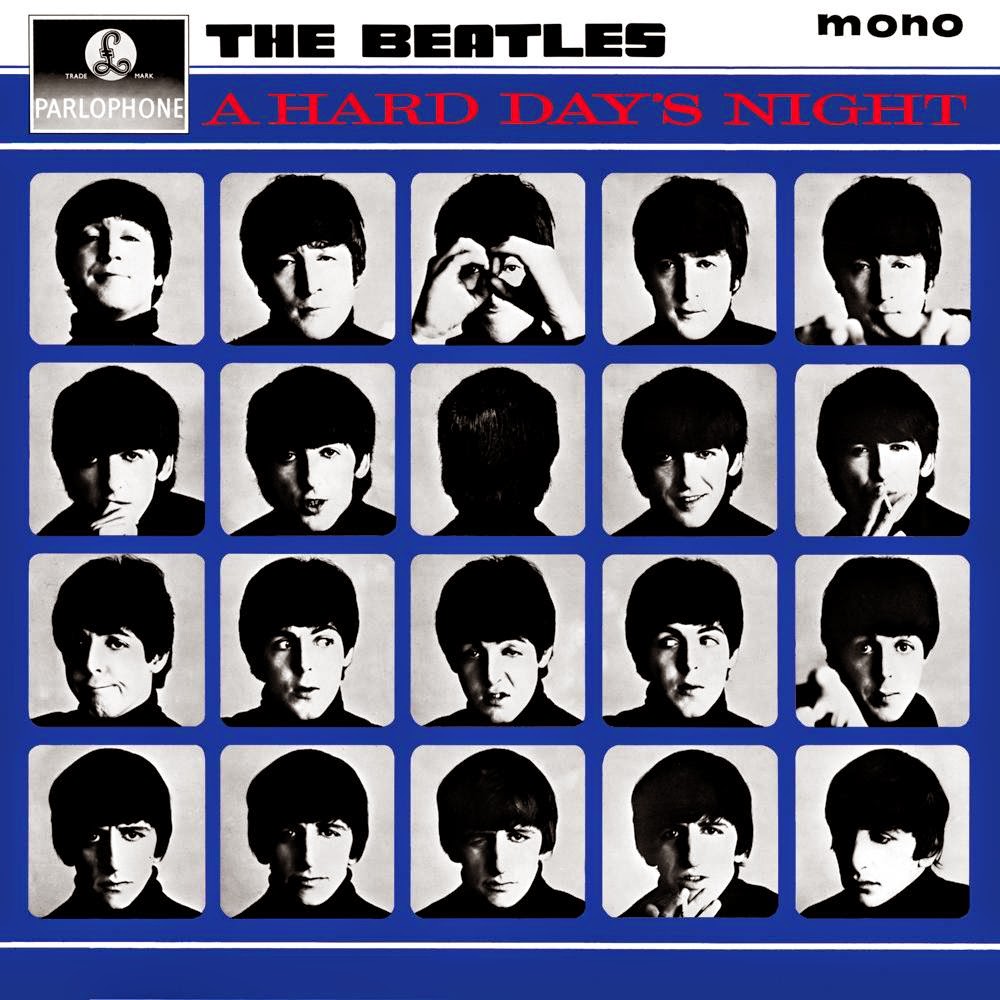
There are quite a few annunciations in the Beatles’ work (my list above includes another example from 1968 and this article spans their whole career), but let’s start with the early years. An incredibly significant track for the Liverpudlians, and a fine place to start any article; AHDN amply demonstrates the tropes which heralded the band’s rise to fame, merged with a now fully-developed sense of their own particular talents, especially with regard to reviving the guitar as a tool to express new forms; and it arrived just following the rejection of the band by Decca records for playing what they foolishly declared to be a dead genre. Ha…
Beginning a song with that single chord sets out their stall immediately. However we’re not here to discuss The Beatles, but what lurks at the 1’18” mark. Just following John Lennon’s lines about how the ‘things’ that his paramour does will make him ‘feel alright’ comes a scream that seems to underline and emphasise the feeling itself. It acts as both a gateway to the solo (in truth, little more than a four bar refrain repeated twice, albeit with doubled octaves achieved with a twelve-string and – possibly – varispeeded to give it a manic edge) while also signalling that it’s ok to really let yourself go. As we all know, these screams and ‘wooooo’s which peppered (haha) the band’s early hits originated in the wild stylings of Little Richard and would often be accompanied by a frenzied shake of the mop top. On Ringo it always looked corny, but for McCartney and Lennon it pushed home the sense that here, finally, was a place to let go of all that pent-up teenage angst and really have what became known in the mid-60s as a ‘rave up’. Crazy, man…
The Kinks – You Really Got Me/All Day and All of the Night
SO much has already been written about and speculated over with regards to Ray and the boys’ first two big chart-toppers. Proto-heavy metal; played by a mystery session man (often incorrectly reported as James Patrick Page); legendary equipment doctoring to get the tone (a la Link Wray with Rumble) etc etc. But what burst it wide open is the way it surrenders to the guitar solo at the mid-way point.
Hot on the heels of A Hard Day’s Night, these two songs by The Kinks are pretty much carbon copies of each other, both in construction and vibe. Why fuck with the formula? Almost as much as the Beatles who paved the way – The Kinks cemented in teenage imaginations the power of announcing when the guitarist was about to get down and dirty. YRGM‘s comes at the 1’16” point ( a kind of mutant gargled ‘Oh, awlriiurghsplurgh’) whereas ADAAOTN‘s comes at 1’19” (a more conventional ‘Oh, come on‘). Backed by Mick Avory’s frankly monstrous beats, both of these solos may be fairly interchangeable, but their wildness and barely-controlled flailing must have seemed outrageous in the summer of 1964.
Compare and contrast with The Beatles’ more sedate reiteration of the main theme. It’s startling how unhinged Dave Davies’ playing is. Due to Ray Davies’ subsequent rise to eminence as the arch-social commentator of middle-English suburban life, it’s often overlooked that the band started life as another London RnB combo, churning out blues standards with a hopped up beat. What’s more, the very annunciation (by Ray) may have led to the very first instance of actual swearing on a hit single, as Ray testifies:
‘Halfway through the song it was time for Dave’s guitar solo. This moment had to be right. So I shouted across the studio to Dave, give him encouragement. But I seemed to spoil his concentration. He looked at me with a dazed expression. ‘Fuck off.’ If you doubt me, if you doubt what I’m saying, I challenge you to listen to the original Kinks recording of ‘You Really Got Me’. Halfway through the song, after the second chorus, before the guitar solo, there’s a drum break. Boo ka, boo boo ka, boo ka, boo boo. And in the background you can hear ‘fuck off’. You can, you can. When I did the vocal I tried to cover it up by going ‘Oh no’, but in the background you still hear it ‘fuck off’. And it’s even clearer on CD, it’s really embarrassing.’
Verily: Apres Les Kinks, le Deluge…
Rick Derringer – Rock ‘n’ Roll Hoochie Koo
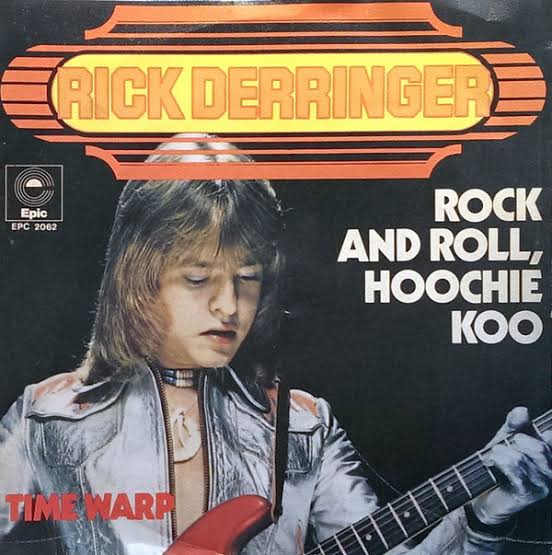
Jumping forward in time nearly ten years… I will forever love this track, not only because it taught me how to spell ‘hoochie koo’, but because it is gloriously dumb. Of course, Rick’s a total pro and has graced many a superb session from Rundgren to Steely Dan, via one of the best singles ever made: Edgar Winter’s Frankenstein. On his All American Boy album this track is the obvious winner, detailing a carefree mid-70s teen suburban lifestyle of ‘getting on down’ that Richard Linklater fondly conjours in Dazed & Confused. At 1’41” Rick asks the rhetorical question: ‘Yeah, did somebody say keep on rockin’?’ followed by a scream that, naturally enough, heralds the solo. And an awesome one it is, too. Lordy mama, light my fuse etc. Unfortunately Rick later drifted into politically murky waters, but for one shining moment etc. etc.
Here’s a vid of Rick (with Edgar Winter) getting on down with the same number on American TV in ’73. Rick notably ups the ‘woo’ factor on about every break, but what really sticks out is how SMALL he looks behind that Les Paul (and how weird the drummer’s shoulders are as well). Still, it rocks…
An honourable mention also goes here to David Bowie, whose ‘Oh hit me’ before Mick Ronson, err… hits him, on Suffragette City, injects a little perversity into the genre. Ta, Dave…
GENRE 1a: Inaudible/Unrepeatable
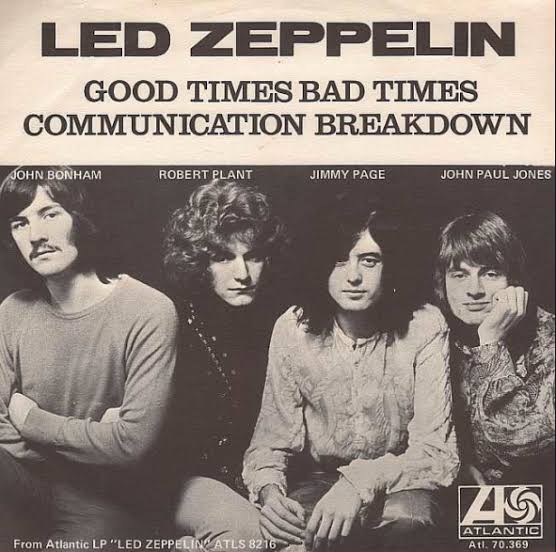
Led Zeppelin – Communication Breakdown (1’23” ‘oooooh, suck’)
A special sub-genre for this track, although I’m pretty sure there are many other examples of what can only be described as ‘faux-orgasmic’ utterances. Step forward, Percy…
Sometimes, let’s face it, guitar solos are just TOO exciting. And sometimes a song is so dynamically supercharged that the anticipation of the aural pasting exhorts the singer to just… well, ejaculate. Here the very king of onstage ejaculation-simulation – Robert Plant – can barely contain his 20-year old excitement at Jimmy Page’s red-hot Telecaster workout. Cleverly constructed with a stop/start dynamic, in the rhythm break just before the solo, Percy fills the space with a kind of weird over-excited spluttering which (to my ears) sounds suspiciously like ‘Ooooooooh SUCK’. The ‘suck’ is timed with John Bonham’s re-introductory snare hit. To be honest, it encapsulates just about every great thing about Zeppelin’s uncanny dynamic chemistry when they first unleashed their blues-rock behemoth on an unsuspecting world. You know… all that tedious stuff that Page constantly bangs on about in any interview about ‘light and shade’, which amounts to the experience and skill to leave as much space as you can in the mix. Even better: Page’s solo doesn’t stop. Take a listen – it just barrels on (and up the fretboard) when Plant returns to sing the chorus. To anyone listening, this band were, at this early point, quite obviously unstoppable on every level. Egos aplenty, these boys…
GENRE 2: Instructional
Dr Feelgood, My Buddy Buddy Friends (1′ 40″ ‘C’mon guitar’)
Elvis Presley, Guitar Man (1’13” ‘Show ’em, son’)
Flamin’ Groovies, Doctor Boogie (0’51” ‘Mow the lawn’)
Iggy Pop, I’m Bored (1’55” ‘Alright Dollface, c’mon and bore me!’)
Richard Hell and the Voidoids, Blank Generation (1’19” – ‘Take It’)
Vain, Ready (1’58” ‘Shoot it, boys’)
Velvet Underground, Oh! Sweet Nuthin’ (2’58” ‘Oh let me hear ya’)
Wild Cherry, Play That Funky Music (2’27” ‘C’mon play some of that funky music’)
In many ways the rise of the guitar solo as a place to shine a light on the skills (or lack thereof) of the axe person must have come as a bit of a cultural shock and a challenge to the singer (or, indeed the rest of the combo, I imagine), who up until this point had been the focal point of fans’ adulation, at least in the world of the hit parade.
But as more and more ‘kids’ picked up the guitar (quite rightly realising that it just may be a way to impress the opposite sex) the singer, sensing a territorial intrusion, found a way to claw back some respect: ie: by instructing the guitarist to play the solo. In this way the singer regained his or her place as alpha in the band pack, with the guitarist relegated to a skilled but subservient beta. A couple of more detailed examples follow:
As we shall see, this often satisfied the dominant urges of many an insecure taskmaster, even to the point where someone as domineering as, say, James Brown, could use the technique to tell the entire band when, and when not to play; actually docking their pay if they failed to comply to his exact specifications.
But James is an outlying extreme. Of course, in the history of rock ‘n’ roll, none could challenge the dominance of the man known as ‘The King’, but by 1967, with a career woefully sidelined by Colonel Tom Parker into schlocky B-movies, even Elvis may have realised that picking skills were now valued at a far higher rate than in 1955.
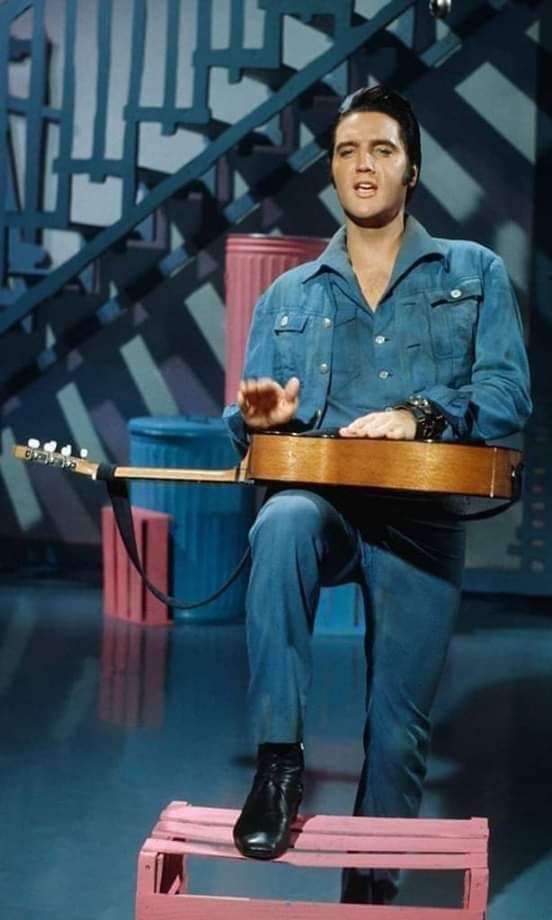
Elvis Presley‘s Guitar Man comes from a film that resides at the bottom of a considerable pile of derivative nonsense that Elvis had squeezed from him by Hollywood studios: Clambake. But in a way it signalled to a MOR crowd who still flocked to see the neutered boy from Tupelo that guitars were now hip currency across the board. A twinkling acoustic solo from session legend Jerry Reed (Elvis, of course, always had great guitarists from Scotty Moore to James Burton) shines in the centre of this tale of a musician searching for a job. And yes, it’s preceded by Elvis himself instructing Jerry at 1’13” to ‘Show ’em, son’. Textually, it’s an odd instruction, considering that the song is sung as if autobiographical, but this is because the original was written by Reed, himself, who had a minor hit with it in the same year. Legend has it that Elvis, when unable to succesfully record the tune, actually asked for Reed to help out, albeit condescendingly with the alleged phrase: ‘Get me that redneck picker who’s on the original tune’. Add to this the use of the southern ‘son’ and we have a prime example of the singer asserting his dominance over anyone who would dare steal his crown.
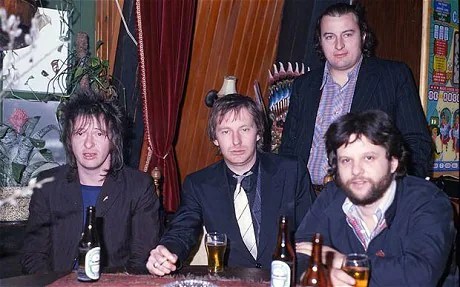
Dr Feelgood, My Buddy Buddy Friends
A decade later, the tough RnB stylings of Dr Feelgood, born in the crucible of south-east England’s pub rock boom had simultaneously pared down the excesses of the early-to-mid 70s while adding a harder, working-class edge to classic Stax and rock ‘n’ roll templates. By 1977, the band had shed their first, iconic guitarist, Wilco Johnson, and thus lost their central focus. The replacement was John ‘Gypie’ Mayo, a disciple of Southern Soul and Kings; both Albert and Freddie. If you watch any of the band’s promotional films at the time they always look hung-over (see above). That’s because they were. Both drink and drugs would eventually lead to Gypie’s downfall but at this point he was the new boy, filling very big shoes indeed.
Not unlike Peter Gabriel’s defection from Genesis, a lot of people saw little future for a band without Wilco Johnson. They needn’t have worried. Indeed, it’s worth noting that it wasn’t until after Wilco jumped ship that the band started having bona fide hits. Yes, they scored a couple of low entries such as Back In The Night and Sneakin’ Suspicion, but, truth be told, by the time their fourth album of the same name was released, their Canvey speedfreak act was beginning to slightly pall. New blood actually revitalised the band and saw them diversify just in time to ride the rise of new wave. Their first album with Mayo, Be Seeing You, was a hard-rocking gem. With Nick Lowe at the producer’s helm (a natural fit, if ever there were one) Be Seeing You never really lets up from start to finish. Covering all the bases from Muddy Waters to Larry Wallis, the material was well-chosen and even made room for a Booker T-style instrumental, with Mayo’s fierce Steve Cropper-isms to the fore. But maybe another reason for the band’s renaissance was the fact that, for once, the band had but one leader – the irrepressible Lee Brilleaux. And it’s sweaty old Lee who barks out the simple order: ‘C’MON Guitar!’ in the midst of the old Charlie Musselwhite number, My Buddy Buddy Friends. And indeed, The guitar does just that.
I’m an avowed fan, but I recommend just about all of Gypie’s work with the good Doctor.
Special award: THE COOLEST
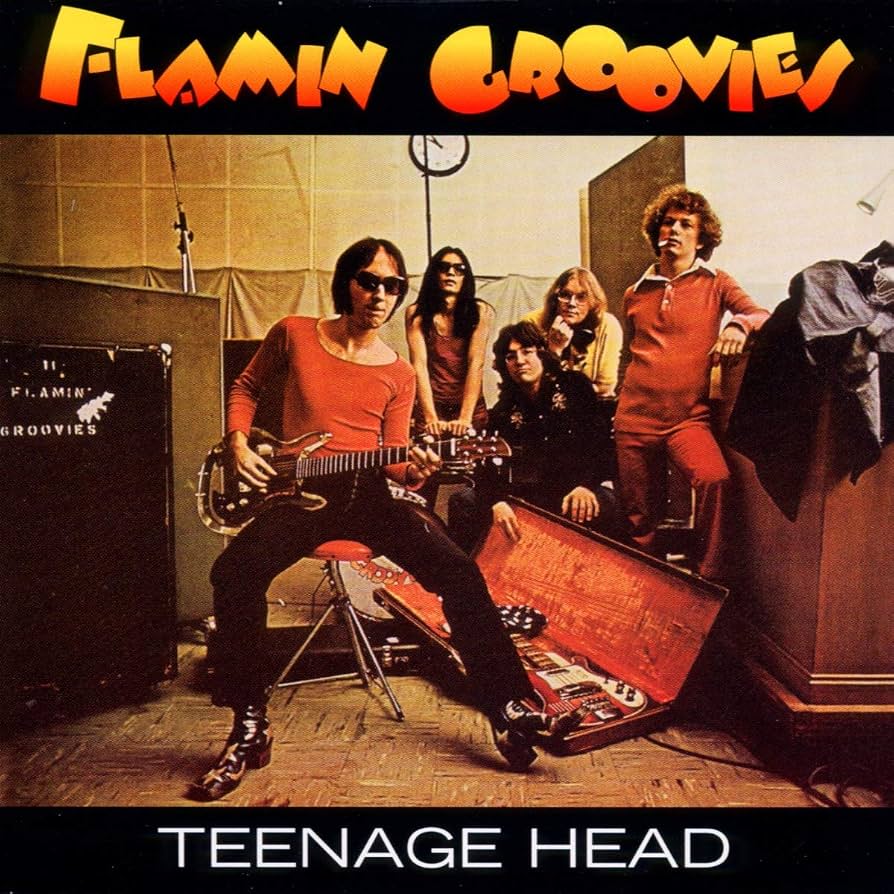
Flamin’ Groovies, Doctor Boogie: Included here as this song was the seed that led to me writing this strange piece. Quite simply, if you’re not aware of the Flamin’ Groovies second and third albums (Flamingo and Teenage Head), you really do need to be. I find them to be superior to the later so-called ‘classic’: Shake Some Action, where all the blues and rockabilly edges have been shorn in favour of dull power pop. Try Doctor Boogie. Short, to the point and rocking. And the annunciation is possibly the coolest. It’s certainly the most laid back and cryptic. Mow the lawn, now…
Now let’s get personal…
GENRE 3: Call Me By My Name
Captain Beefheart and the Magic Band, Big Eyed Beans From Venus (0’54” ‘Mr Zoot Horn Rollo, hit that long lunar note and let it float’)
Vivian Stanshall & Kilgaron, The Young Ones (1’55” ‘Alright Lee, if you must’)*
Stevie Wonder, Looking For Another Pure Love (1’57” ‘Do it, Jeff’)
Aerosmith, Shame On You (1’27” ‘Joe Perry, Ooh, Mr Style, Some kind of killer bee, buzz awhile’)
The Beatles, Honey Don’t (1’15” ‘Ah, Rock on, George, one time for me’)
Van Halen, Could This Be Magic? (2’08” ‘Edward? Thank you’)
Spinal Tap, Gimme Some Money (1’03” ‘Go, Nigel, Go!’)
Jimi Hendrix Experience, Fire (1’09” ‘Oh, move over, Rover, and let Jimi take over. Yeah you know what I’m talking about… Yeah, get on with it., baby.’)
*special comedy award
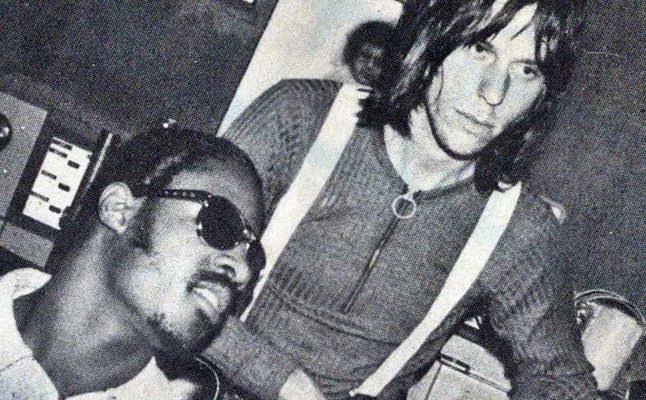
Possibly the most fun variant: This genre, obviously, has the singer name-checking the guitarist, as a sign that six strings are about to get involved. These can be both instructional AND complimentary; just check out Stevie Wonder’s exhortation (which actually comes a few bars into the solo itself) for Jeff Beck to ‘Do it’ on Talking Book‘s Looking For Another Pure Love. You can hear how much Stevie just knows that Jeff’s gonna deliver.
Award for the most stilted and UN-rocking is Ringo’s Liverpool hepcat thing, on Honey Don’t, while the award for most polite surely goes to David Lee Roth on Could This Be Magic?, but he was possibly being sarcastic; I’m no expert on the band’s history. Most notorious of all has to be Captain Beefheart’s pre-solo rumble of instructions to Bill Harkleroad on Big Eyed Beans From Venus; which is probably the most detailed of any examples here, considering that he even tells poor Bill how to play the solo. Ever the taskmaster.
The three by Jimi Hendrix, Spinal tap and Viv Stanshall can all be considered comedy entries in one way or another. Hendrix’s mainly because the ‘Rover’ asked to move over was, as legend has it, a real dog that belonged to Noel Redding’s mum and who Jimi wanted to move so he could get nearer to the fireplace in her front room (FACT). Spinal Tap because, well, you know… and I just adore Viv’s dismissive ‘if you must’.
GENRE 4: Warning
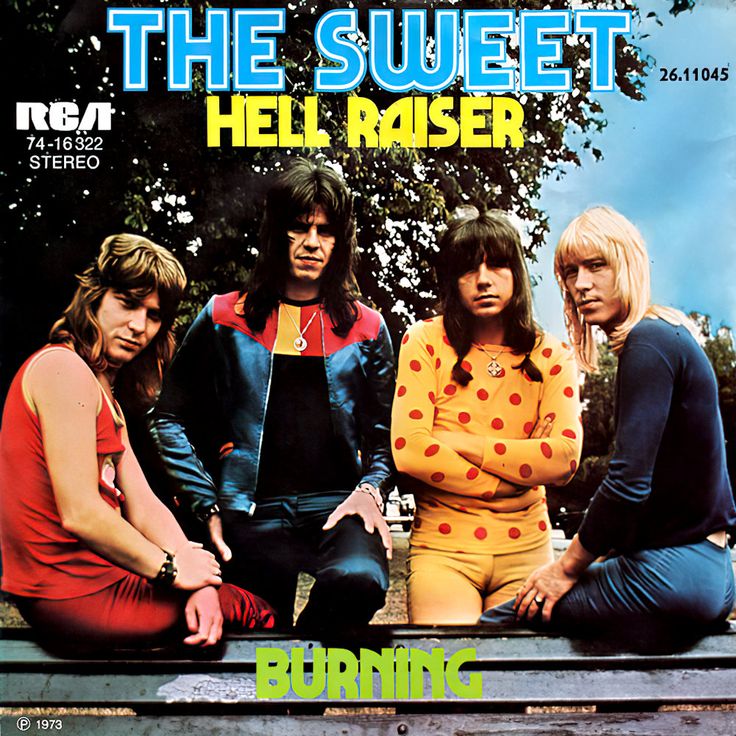
Sweet Hell Raiser (1’58” ‘Look Out!’)
Thin Lizzy Jailbreak (2’18” ‘Breakout!’)
Possibly self explanatory: The Sweet overuse theirs, particularly as it’s the first thing you hear on the single, and by the time the solo finally arrives it’s so short as to barely qualify. But hey, it was the second or third single I ever bought and I love it.
GENRE 5: Let’s get meta
The Beatles, For You Blue (‘Go, Johnny, Go’)
The Clash – Complete Control (‘You’re My Guitar Hero’)
Steve Hillage, New Age Synthesis (Unizipping The Zype) (4’12” ‘ I don’t wanna be a guitar hero, I wanna be a guitar ZERO!’)
The Yardbirds – (The Nazz Are Blue 1’42” ‘Ohhh, oh yes’)
Many guitar solos have the sense that they’re being announced, but really they have succumbed to meta-commentary. This often occurs when the lead singer or other band member ‘comments’ on the solo in progress. This is less of an announcement that you better watch out because the guitar-player’s about to get busy and more a roar of approval from his or her peers. This is often ironic, let it be noted. Several examples spring to mind in this category:
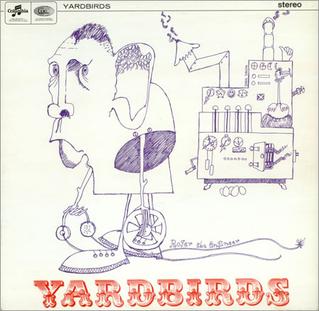
A band that were both hit-makers and also-rans in every sense. To modern ears The Yardbirds can, to say the least, sound problematic. Cursed with half-arsed production values, sidelined by commercialism (which famously led to their original guitarist fleeing the ranks in a fit of purist pique), these West London ravers were, by every contemporary account, a blistering live ticket but woefully under-represented on vinyl. Apart from a string of superb singles, primarily showcasing the evolution-in-progress of the electric guitar in the hands of one single genius: Jeff Beck, the band sound rather weedy on most of their studio work. The problems mostly begin and end with their lead singer: asthmatic and with little range; Keith Relf was always a liability for the band, especially as he had a tendency to overcome limitations by means of alcohol. But he looked the ticket and played reasonably good blues harp. Enough to front Eel Pie Island’s hippest combo, at least.
However, on The Nazz Are Blue it’s not Relf’s voice that repels modern ears, the squeaky noise here belongs to Jeff Beck himself. The track’s a clumsy boogie from their Roger The Engineer opus that sort-of emulates an Elmore James structure (albeit sans slide), contains lyrics that sound like blues-cliches mixed up with some nonsense about Jeff’s blue car invented on the spot and a solo that – while doing extraordinary things with feedback – for a musician of the caliber of Beck it underwhelms, to say the least.
Worst of all, at the end of the solo Jeff emits a little squeal that’s less rave-up and more mince-up. For a genre that demands a certain bruising sexuality, this commentary has the directly opposite effect. I’m really not sure if this was actually intended as a joke. But it makes Hi Ho Silver Lining look almost macho.
A more acceptable example of meta-commentary from the ‘Birds is their majestic Happenings Ten Years Time Ago single. Recorded at the point where Jimmy Page was about to replace Beck as lead guitarist, this singular example of the two guitar giants battling on one track really goes to town during the solo. The ‘commentary’ here is, in true swinging London ironical fashion, a spoof conversation, again by Beck, drawn from a visit to a health clinic about the band’s long hair and success with girls. This underlies one of the great guitar moments of the mid-60s where police sirens, exploding bombs and more get conjured up. Both truly psychedelic and groundbreaking, with a classic Page stuttering raga riff, it barely broke into the top 50 in the UK. Now that IS mind-blowing…
The Beatles – For You Blue
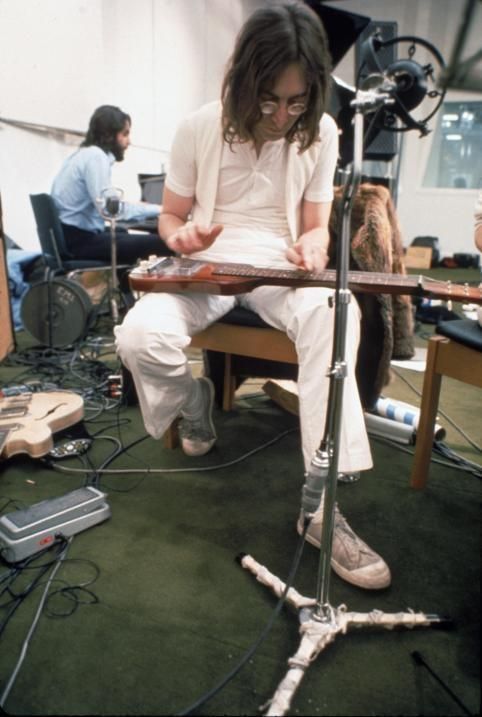
Ah, the Fab Four once more… ‘written’ by George Harrison (my opinion on George has already been expressed earlier in this blog) for the Let It Be sessions, this cute little twelve bar shuffle hardly stretches a band who spent a large part of their relatively recent past playing three-chord standards, for five or six nights a week in roughest Hamburg to unimpressed sailors. The highlights, if any, are provided by Lennon’s nifty lap slide work. His solo slot (basically bringing the same chord work to the fore) is accompanied approximately halfway through at the 1′ 07” mark by George’s rather sarcastic, ‘go, Johnny, go!’ quip. The sense of it all being an ironic glance back at simpler times is then reinforced when George sings at the close of the solo: ‘Them old twelve bar blues’, as if to draw attention to the detached sense of ‘fun’, which was notably absent from most of the sessions for this: the worst Beatles album by a mile. Not even McCartney’s rather ego-driven ‘Naked’ re-release and remix (removing Phil Spector’s awfully mis-judged slush) could save this portrait of four men, utterly sick of each other.
The Clash – Complete Control
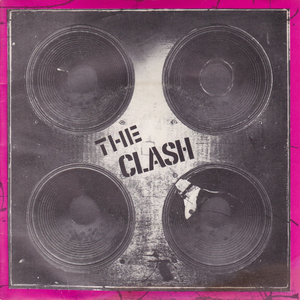
I used to own this single, and, to be honest, I think it was probably the last thing by West London’s agit-prop icons that I ever really loved. Many aspects of my distant youth have palled, as will many callow preferences, but The Clash have suffered more than most, if only because in these more cynical times, their brand of prosletizing seems both naive and culturally insensitive. Yes, I know their hearts were in the right place, and yes, I know that they never really aspired to cultural appropriation (stand up, Sting). Besides which, this single was produced by LEE PERRY, of all people. But for all of Joe Strummer’s (seemingly genuine) bond with the proletariat (or, at least, the working class kids with enough taste to attend their gigs) and their genuine love of West Indian culture, what remains is those pictures of them, always straining to look their fucking coolest. Grown men in costumes. Give me a break…
Anyway – while Complete Control was a big step up from the garage band ineptitude of their first album (the structure is remarkably un-punk, belying a sophistication and variety that would finally emerge on London Calling), their aim here was incredibly self-centred. Here we get 3’10” of – basically – whingeing about how their record company released a single without their permission. Big deal. Anyone from the dawn of recorded music onwards was prey to the whims of the music industry. It didn’t make then any more punk to write a song about it: Van Morrison and Robert Fripp (to cite two random examples) have been moaning about record companies to anyone who would listen, forever.
But this is maybe a little harsh. Strummer’s desire to fight back against the ‘man’ is obvious (again, sometimes his roots are so middle-class intellectual/early 70s Notting Hill, it hurts) along with the band’s collective desire to deconstruct the language of rock that prefigured this 1977 release. Hence: during Mick Jones ‘solo’ (really a few bare picked notes following a reverbed arpeggio moving up the fretboard) is decorated with Strummer shouting ‘you’re my guitar hero!’. At the time it seemed quite revolutionary to my young ears. Now it just seems mildly amusing.
People still play guitar solos, and Joe has left us. The world is a harsh place, but at least it allows me to also include Complete Control‘s opposite number: Steve Hillage’s wonderful New Age Synthesis (Unizipping The Zype) originally from the studio side of his Live Herald album (and later included into the CD version of Open), released a year and a half later. It’s possibly the most meta example of all, as Steve, a genuine guitar hero, tells us that he doesn’t want to be a guitar hero just before demonstrating what a guitar hero he really is. A proto-humblebrag, if you will… and a brilliant place to stop.
So there you have it, five genres of the annunciation. Proof that guitar solos really were worth shouting about back in the day.
The playlist can be found here. And as I say, feel free to offer more examples!

